How We Installed an IKEA Kitchen in a Tiny Apartment—With a Little Help from Murphy’s Law
After months of planning and work, I finally finished the small living and kitchen space I’ve been promising to show. Today I’ll walk you through the kitchen installation and the challenges we faced—because when it comes to DIY, Murphy’s Law always seems to apply. I’ll share the bedroom projects in a later post.
For years this corner served mainly as storage and housed our washing machine. When we moved to Greece we brought an American-sized machine that didn’t fit in the bathroom, so it lived here. I’d even written about my “elephant in the room” years ago.
After clearing everything out, we were ready to start.
We chose a prepackaged IKEA kitchen set—one of those limited deals within the Knoxhult range—and planned to place the cabinets along this wall while keeping the washing machine where it was. Simple, right? Not quite. The plumber who had routed the pipes had installed the washing machine hookups at the wall and placed the sink plumbing where the washer sat. That mismatch forced us to rethink the entire layout.
We scrapped the original plan and redesigned the lower cabinet configuration. The upper cabinets stayed, but we had to rearrange the base units. The stove went into the corner with a small cabinet next to it, leaving a larger gap in between that needed a practical solution.
Behind the washing machine there was a confusing tangle of hoses and pipes—definitely not ideal.
After one more rearrangement we moved the sink to the spot where the washer had been. That felt workable, but more odd plumbing placements meant we couldn’t simply slide a standard cabinet into place. The sink cabinets came without backs because they were designed to sit flush against a wall, so we had to improvise.
The pipes were tucked in awkward spots, and cutting the cabinet to fit around them wasn’t an attractive option. At one point I wondered why people pay professionals—then a good friend stepped in to help with the tiling and general installation. Their help was indispensable.
Once the tiles went up the whole space started to come together. We decided to run the backsplash all the way down to the countertop, which made a dramatic difference visually and will be much easier to clean. Fortunately we already had the tiles, which saved time and money.
We opened holes in the side of the sink cabinet and fed the pipes through. The faucet now works, although we still plan to tidy that area later. The toughest task was fitting the sink into the countertop—those clamps are fiddly and required multiple attempts before everything seated correctly.
For the cabinet back I found an old piece of plywood and varnished one side to make it water-resistant. I attempted to match the counter color but didn’t quite succeed—another example of Murphy’s Law in action. We screwed the plywood into place so it fit flush with the sink cabinet and the adjacent column.
Disclosure:
The links below were affiliate links on the original site. If you purchase through affiliate links, a small commission may be earned at no extra cost to you. I include these to support ongoing content creation.
The Reveal
Despite the time pressure—I was leaving for America shortly after installation—we completed the kitchen in time. We painted the washing machine to blend it with the cabinets, which made a surprising improvement to the overall look.
The door next to the sink opens onto the balcony, and my blue kitchen organizer hangs beside it. There’s still a small gap between the cabinet and the column where the pipes are—my husband plans to build a removable cover so we can access the plumbing when needed.
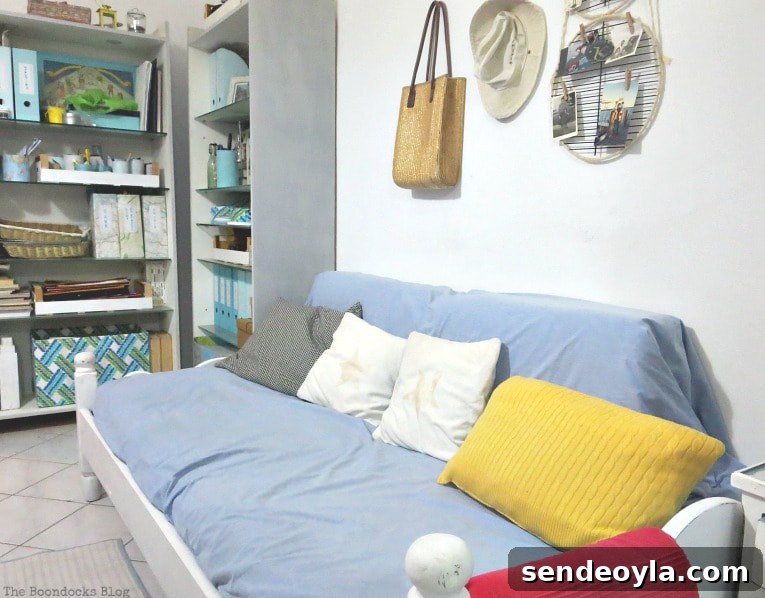
I also finished an IKEA Hejne shelving unit and added two more shelves for extra storage—every inch counts in a small apartment. Covered fabric baskets help hide broken plastic bins and keep things tidy.
The fridge sits between the shelving and the daybed—proof that this is a compact living space. Across from the daybed you can see the painted plywood panel we installed alongside the sink cabinet; I painted it a soft gray so it blends into the room rather than standing out.
In the opposite corner sits a metal trunk I refurbished months ago. Many of the soft furnishings—like those curtains—were repurposed from old duvet covers. Reusing and upcycling has been a guiding principle throughout this small apartment renovation.
This project was long and sometimes messy, but the end result proves that creativity, careful planning, and a little help from friends can transform tight spaces into functional, cheerful homes. My goal was a calm, bright space to stave off the winter blues, and I think we succeeded.
Thank you for following along. I have a few more bedroom projects to share before I consider this small apartment finished—at least until the next redecoration kicks in!
If you enjoyed this tour, feel free to share or save the images. Subscribe to the blog to receive updates and future DIY tutorials.
More DIY Projects
Note: This blog is for entertainment and inspiration. DIY tutorials are not professional advice. I appreciate your comments—please avoid adding hyperlinks in comments so they can be published.