
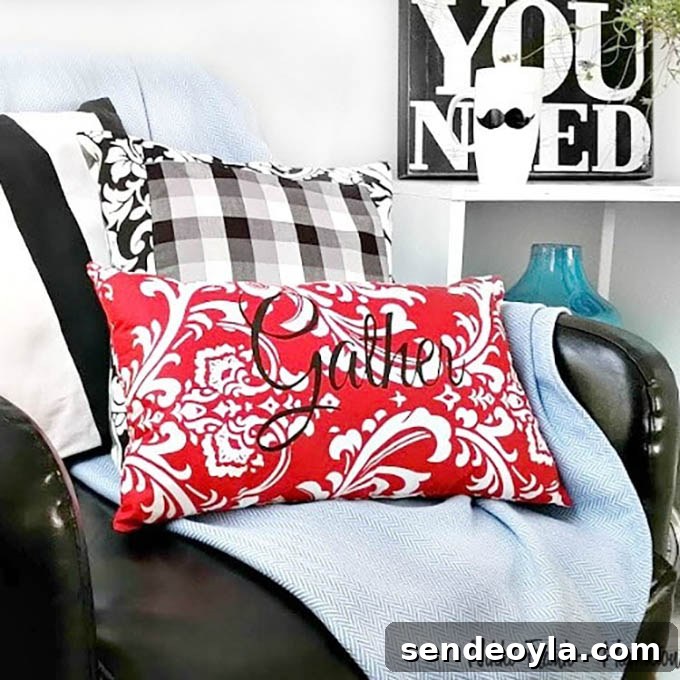
Today is a special day — my friend Nikki Frank Hamilton from Indiana is visiting me here at The Boondocks. Nikki writes at View From In Here and runs the Make Lemonade Shop where she sells handmade pillows. She’s sharing a step-by-step tutorial for a DIY graphic pillow you can make with or without a sewing machine, and she generously provided the graphic used in this project. Nikki, take it away!
I’ve always admired Mary’s blog and imagined her Greece-like photos: the unbelievably blue sky and sea, the peaceful sound of waves, and the charm of winding mountain roads. I haven’t met Mary in person yet, but I’m delighted to be guest-posting on The Boondocks today. Thanks for having me, Mary — one day we’ll meet face-to-face!
Over time, I’ve learned a few things about Mary: she treasures family time, she’s a talented creator who can repurpose almost anything into something beautiful, and she surrounds herself with pretty things. That inspired this collaborative project — a hand-painted graphic pillow that captures Mary’s style: pretty, practical, quick, and budget-friendly.
DIY Graphic Pillow – Mary Style
Through my Make Lemonade Shop I hand-paint pillowcases using artist paints, which can take a few days to complete. For this tutorial we focused on a simpler, faster technique using freezer paper stencils and fabric crayons. The project is inexpensive, requires minimal supplies, and produces a lovely graphic pillow suitable for year-round use or seasonal decor. I chose the word “Gather” on a red scroll-patterned fabric, but you can use any graphic and fabric you like.
DIY Graphic Pillow
This project emphasizes cost, simplicity, and an attractive finished look. You don’t need a sewing machine or a cutting machine like a Silhouette or Cricut — though those tools can speed things up if you have them. The concept is to create a crisp graphic on patterned fabric using a freezer paper stencil and Tulip fabric crayons, then sew or hand-stitch the pillow together.
Supplies needed for DIY Graphic Pillow:
For a small bolster or a larger pillow front from a half-yard (45″ wide) of fabric:
- 1/2 yard of fabric
- Freezer paper
- A printed copy of your graphic (8.5 x 11″ for a bolster, 11 x 17″ for a larger pillow)
- X-Acto or craft knife with a sharp blade
- Masking or painter’s tape
- Tulip fabric crayons (white and black pack works well)
- Matching or white thread
- Sewing scissors
- Iron
- Poly-fill stuffing (16 oz. bag)
Step One — Prepare the Fabric
Fold the half-yard of fabric in half. You can make two small bolster pillows or one larger pillow from this amount. For two bolsters, cut the folded fabric so you have two pieces roughly 18″ wide by 11¼” high. Each pillow needs a front and a back piece.
Step Two — Make the Stencil
Use freezer paper to make a stencil: it irons to fabric and produces crisp edges. Stack two sheets shiny-side down if you want to cut duplicate stencils at once. Center your printed graphic on the paper, mark the center lines both on the paper and the graphic, and tape everything to a hard surface. Cut the graphic with a sharp X-Acto knife, cutting through both layers if stacked. Keep the small interior pieces from letters like “g,” “a,” and “e” to insert later.
Step Three — Position and Iron the Stencil
Find the center of your fabric by folding it twice and creasing lightly. Align the stencil using the center marks so the word sits straight on the fabric. Iron the freezer paper stencil onto the fabric with medium-high heat, starting at the edges and working inward. If the iron is too hot you’ll lose the wax backing and shorten the stencil’s life; iron at a temperature that adheres the stencil firmly without scorching. Insert the small inner pieces of letters and press them down as well.
Step Four — “Paint” with Fabric Crayons
Use Tulip fabric crayons to fill the stencil. Work in small sections — color an inch at a time, then smudge the crayon into the edges with your finger to achieve an even, filled-in look. If you color too large an area at once it will dry and won’t smudge smoothly. Once the stencil area is fully colored, smudge it a second time for a sharper finish.
After coloring, carefully peel off the stencil so it can be reused. Let the design dry for at least 24 hours before heat-setting. To set the pigment, place a pressing cloth over the graphic and iron on high heat, following the fabric/crayon manufacturer’s instructions. Properly adhered freezer paper stencils can be reused several times, making this method ideal for producing multiple pillow fronts or gifts.
Step Five — Sew and Stuff the Pillow
Place the front (graphic) and back pieces right sides together. If using a sewing machine, stitch a 1/2″ seam allowance around the edges, leaving a small opening for turning and stuffing. Finish raw edges with a zigzag stitch if desired. To hand-sew, use a doubled thread and small, closely spaced stitches for strength. Clip the seam allowances at the corners (without cutting stitches) and turn the case right-side out, using a pointed tool to push out corners.
Fill the pillow with poly-fill, working the stuffing into the corners first for a full look. Fold the seam edges inward and pin closed, then hand-stitch the opening with a hidden slip stitch or machine-stitch it closed about 1/2″ from the edge. Smooth and shape the pillow, and you’re done.
We’re Finished!
This quick project took about an hour to make two bolster-style pillows. The layered patterned fabric with a bold hand-painted graphic creates a polished, handmade look. Approximate cost for two pillows: fabric (half yard) $2.44, stuffing $3.50, fabric crayons $3.99, and a printed graphic about $0.20 — a budget-friendly way to make stylish gifts and seasonal decor.
- Fabric (half yard) — $2.44
- Stuffing (16 oz.) — $3.50
- Paint crayons (pack) — $3.99
- Copy of graphic — $0.20
If you’d like this exact “Gather” graphic, a download is available where Nikki originally posted the project. These pillows are a great handmade gift and a lovely way to update your decor without spending a lot.
Thanks for reading — I hope you enjoy making your own graphic pillows. For more handmade pillow ideas and tutorials, visit Nikki’s blog at View From In Here and her Make Lemonade Shop for finished pieces. Happy crafting!